
Gates Foundation Addresses Claims Of Releasing Mosquitoes In Nairobi
The foundation acknowledged awareness of the circulating reports
 Marvin Chege
The Gates Foundation has pushed back against viral online claims, branding them false and misleading, following allegations that it runs a Nairobi-based laboratory where mosquitoes are released into the environment.
In a statement posted on its social media accounts on Monday, February 9, the foundation acknowledged awareness of the circulating reports and flatly rejected them.
"The Gates Foundation is aware of social media posts claiming that we release mosquitoes in Kenya. This claim is false," the foundation stated.
"The Gates Foundation does not release mosquitoes, operate laboratories that do so, or run vector-control activities in Nairobi or anywhere else."
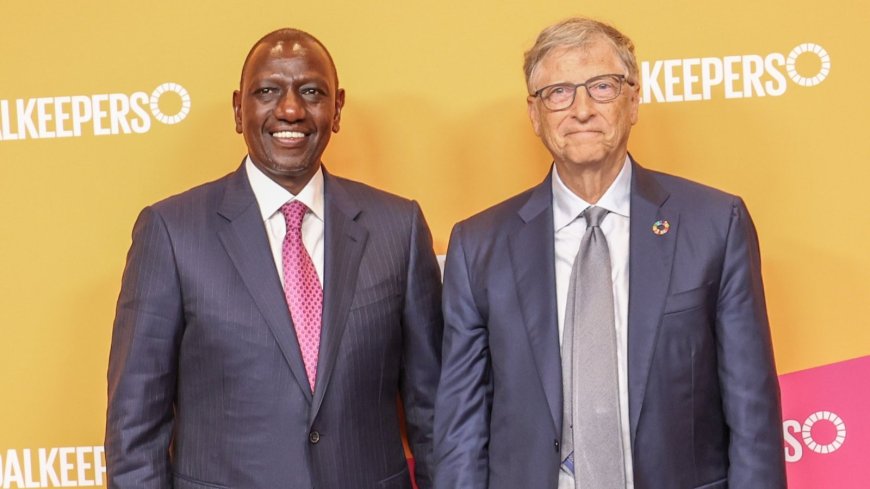
President William Ruto and Bill Gates in New York, USA on September 20, 2023. /WILLIAM RUTO.X
It clarified that malaria prevention and control initiatives in Kenya are driven by the government, with the foundation’s role limited to supporting state-led priorities.
The organisation emphasised that its support is delivered openly and responsibly through recognised partnerships with public health bodies, researchers, and other stakeholders.
The response follows a surge of social media posts alleging that the foundation had released genetically modified mosquitoes from a laboratory in Nairobi to wipe out malaria-carrying species.
Some of the posts claimed the mosquitoes were biting residents and causing harm, particularly to children and older people. While dismissing these assertions, the foundation acknowledged that it works with other organisations on malaria elimination efforts involving gene drive technology.
According to the foundation, gene drive falls under a broader category of genetically based vector control (GBVC) tools currently under scientific study to curb malaria transmission.
The technology works by altering the genes of malaria-carrying mosquitoes so they either cannot transmit the disease or their populations reduce over time. The approach targets only malaria-transmitting species, leaving other mosquitoes unaffected.
The Gates Foundation backs the research due to malaria’s continued global toll, which it estimates at nearly 600,000 deaths annually, most of them African children. It noted that while interventions such as bed nets and medicines have saved millions of lives, they have not been sufficient to eliminate the disease entirely.
The foundation also highlighted that local communities and stakeholders are typically involved in decision-making around new public health interventions. It pointed out that partnerships with African institutions are aimed at ensuring broad community engagement on genetically modified vector control tools, including gene drive.
Under this funded research, experimental releases of male mosquitoes have taken place in Burkina Faso since 2019. However, the Burkina Faso government halted the project in August 2025 over safety and environmental concerns.
In Kenya, the Kenya Medical Research Institute (KEMRI), working with Imperial College London, is planning the introduction of genetically modified mosquitoes as part of efforts to combat malaria-transmitting species.