Information, Communication, and Technology (ICT) Cabinet Secretary William Kabogo has disclosed that billionaire entrepreneur Elon Musk will be required to establish local offices for X (formerly Twitter) in Kenya within the next three months as the government moves to tighten regulation of international social media platforms operating in the country.
Speaking before the Senate on Wednesday, May 13, Kabogo revealed that the government had granted X temporary approval licences to continue operating in Kenya, but tied the approval to a strict condition requiring the company to set up a physical presence locally.
“And you remember, Mr Speaker, if I may add, a platform like the one for Elon Musk. We have given them temporary approval licences to operate in Kenya on the condition that in the next three months they shall have an office here,” Kabogo told senators.
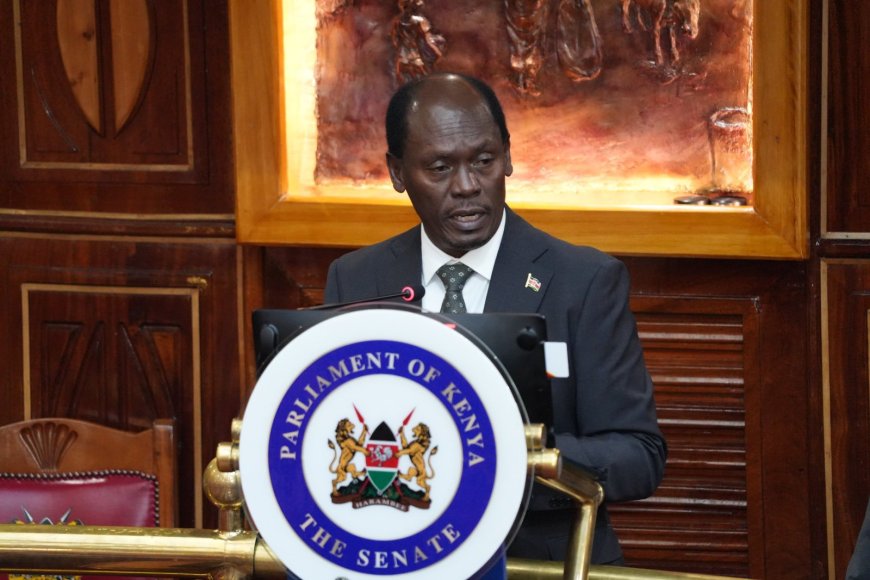
ICT Cabinet Secretary William Kabogo, before the Senate on May 13, 2026, addressing concerns regarding cyberprotection. /WILLIAM KABOGO GITAU
The CS explained that the government’s latest measures form part of a wider crackdown targeting global digital platforms that have increasingly faced criticism over the spread of harmful content, misinformation, cyberbullying, and online safety threats, particularly those affecting children and vulnerable internet users.
Kabogo maintained that compelling the platform to establish offices in Kenya would strengthen the government’s ability to enforce local laws and regulations whenever disputes arise or harmful material is published online.
“So we are taking action by having them here in Kenya and being subjected to our laws and measures that are there to protect our children,” he stated.
The ICT CS further revealed that the Communications Authority of Kenya (CA) had now been granted expanded powers through new regulations, allowing it to suspend operations of global digital platforms found to be in breach of Kenyan laws or government directives.
Kabogo singled out platforms such as TikTok, Meta, and X, indicating that the government was pursuing stricter accountability mechanisms to ensure the firms no longer operate remotely without direct oversight from Kenyan authorities.
“On what we are doing, Mr Speaker, with players like TikTok and Meta, one action is the take-down action,” Kabogo remarked, adding: “The other action, Mr Speaker, is that the Communications Authority, through regulations, has been mandated now to stop operations of those platforms in the event of a breach.”
The revelations come at a time when social media continues to dominate Kenya’s information landscape, according to the latest State of the Media 2025 report released by the Media Council of Kenya (MCK).
The report, unveiled on Monday, May 4, during commemorations marking World Press Freedom Day 2026, showed that social media had overtaken traditional media platforms as the leading source of news for Kenyans.
According to the findings, 39 per cent of Kenyans relied on social media platforms for news and information in 2025, compared to 31 per cent who preferred television, while radio accounted for 21 per cent of news consumption.
The report pointed to a significant shift in media consumption habits, with more Kenyans increasingly turning to digital platforms for information, entertainment, and education.





![itel To Unveil Flagship Smartphone S23+ [FEATURES & PRICE]](https://viraltea.co.ke/uploads/images/2023/11/image_380x226_654b6e0fcdb10.jpg)